Current and recent research. Coursework projects are on the projects page.
DDR4 PHY Receiver Front-End
Dual Degree Project (EE 691) · Aug 2025 – present · In progress
Department of Electrical Engineering, IIT Bombay
Prof. Laxmeesha Somappa (Guide)
The goal is a receiver front-end for a DDR4-class link at 1.6 Gbps (unit interval 625 ps, Nyquist frequency 800 MHz) in TSMC 65 nm CMOS with a 1.2 V supply. The channel is modelled with a physical multi-conductor transmission line (Cadence mtline, FieldSolver wideband model) instead of ideal RLC sections, and ideal resistors and capacitors are replaced by the process's rnpoly resistors and MIM capacitors.
The first result concerns the channel itself. Loss at the Nyquist frequency grows with trace length and is very small for realistic DDR4 traces: below 0.02 dB at 2.5 cm, 0.08 dB at 10 cm and 1.2 dB at 90 cm. Significant loss needs either a much higher data rate or a much longer channel, so the amount of equalization a link needs is set jointly by length and data rate.
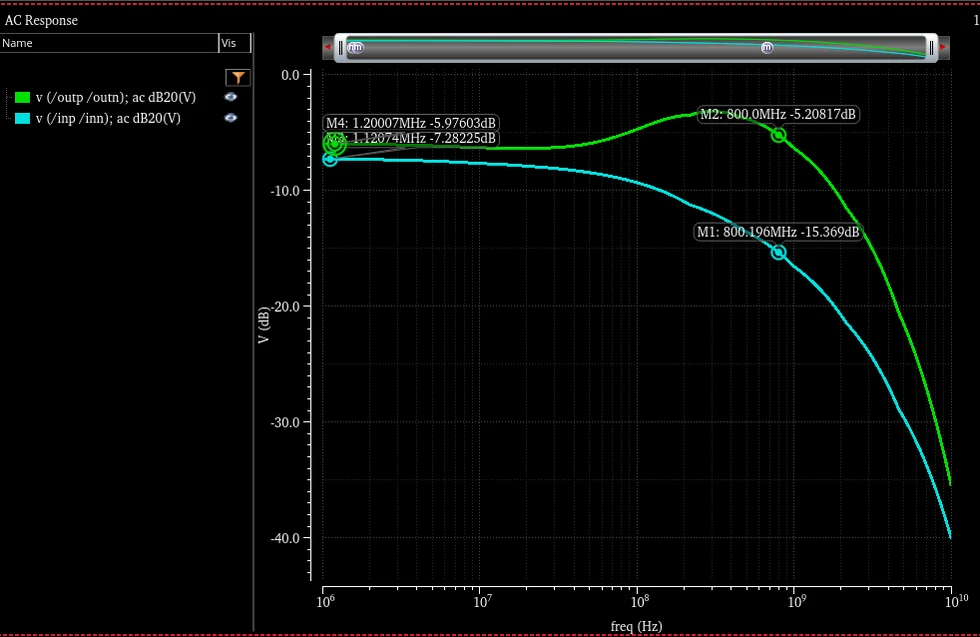
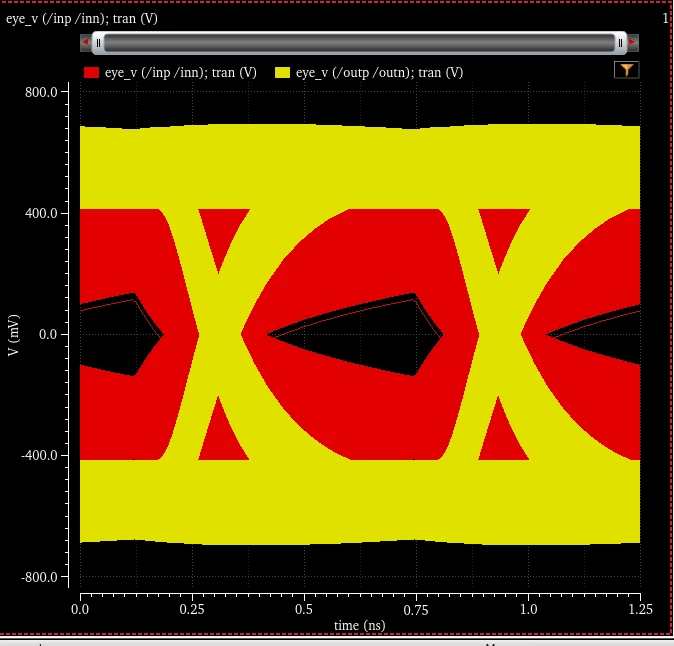
To study equalization where it matters, I used an intentionally long 8 m line, which rolls off by 8.09 dB between DC and 800 MHz. A source-degenerated CTLE (differential pair with an RS–CS degeneration network) designed for 8.87 dB of peaking at 800 MHz flattens this response to within 0.77 dB, raises the eye SNR from 8.39 dB to 18.45 dB and cuts peak-to-peak jitter by 69%. At the 2.5 cm trace the channel is nearly flat, so the CTLE is not needed for loss there; it stays in the chain for signal conditioning, common-mode rejection and isolation of the channel from the comparator.
Receiver signal chain. Solid: designed and characterised. Dashed: in progress.
Roll-off at 800 MHz relative to DC, against trace length (mtline, 1.6 Gbps).
Trace length
Roll-off (dB)
2 cm
0.010
5 cm
0.030
10 cm
0.080
30 cm
0.4
90 cm
1.2
800 cm
~8
AC response of the 8 m channel, without and with the CTLE.
Metric
Channel only
Channel + CTLE
Gain at DC
−7.28 dB
−5.98 dB
Gain at 800 MHz
−15.37 dB
−5.21 dB
Roll-off to 800 MHz
−8.09 dB
+0.77 dB
Eye measurements at 1.6 Gbps over the 8 m channel.
Metric
Without CTLE
With CTLE
Eye height
253 mV
831 mV
Eye width
386 ps
534 ps
Amplitude
449 mV
1077 mV
SNR
8.39 dB
18.45 dB
Peak-to-peak jitter
279 ps
91 ps
Rise time
242 ps
158 ps
AC response of the 8 m channel without the CTLE (cyan, −15.37 dB at 800 MHz) and with it (green, −5.21 dB at 800 MHz).Eye diagram at 1.6 Gbps over the 8 m channel. Red: channel output. Yellow: CTLE output.
Next
Add a decision feedback equalizer (DFE) and clock-and-data recovery (CDR), then close the loop.
Full-rate transient simulation with BER validation (target below 10−12).
Research visit, RPIT’26 · Jun 2026 – Aug 2026 · Completed
Laboratoire des Solides Irradiés (LSI), École Polytechnique, Institut Polytechnique de Paris
Dr. Raja Sen (Main supervisor and co-author) · Dr. Nathalie Vast (Scientific supervisor)
A first-principles characterisation of monolayer 2H-MoS2 with density-functional theory (PBE) in Quantum ESPRESSO, covering its structural, elastic, electronic, vibrational and spin–orbit properties. Each computed quantity is checked against the others and against published values.
The elastic constants give a layer incompressibility modulus of about 84 N/m, within roughly 1% of the literature, which validates the computational setup. The band structure has a direct gap of about 1.68 eV at K, and the phonon dispersion has real frequencies across the whole Brillouin zone, so the structure is dynamically stable at equilibrium. Spin–orbit coupling splits the K-valley valence band by 148 meV, and a maximally-localised Wannier function model reproduces the bands with a few meV of RMS interpolation error.
NUS Graduate School and SCALE, National University of Singapore
Selected for the 2025 NUS Young Fellowship Programme. The programme included mentored research tutorials, meetings with faculty and visits to laboratories in Singapore. I presented a research poster and an oral talk, took part in the 3-Minute Thesis (3MT) challenge, and met a cohort from many disciplines who were considering research and doctoral study.